Why You're Not as Rational as You Think
Your brain was built for survival in a dangerous world, not for desk jobs or rational decisions. Here is why ancient wiring still drives every decision you make today, and why that is not a flaw.
If we are to resist thinking in rigid categories, we have to start with the most foundational "bucket" of all: our evolutionary history. Before we can look at what happened one second ago in the brain, we have to understand the ancient software that was written millions of years before we were even a species.
It was a simple question: why do we behave the way we do, even when we know better?
The answer sits in three numbers.
The Numbers That Should Humble Every One of Us
Before we get into why we behave the way we do, let's set the stage.
- 6.7 million years: That's how long our ancestors have been walking upright on this planet.
- 2 lac years: That's how long Homo sapiens, modern humans, have actually existed. Barely a blip.
- 5,000 years: That's all civilization is. Law, religion, culture, mathematics, discipline. Everything we're supposed to live by fits inside this tiny window.
Sit with those numbers for a second. The gap between them is the whole point. Everything modern life expects from us, sitting in classrooms, following rules, making "rational" decisions, is built on that tiny 5,000-year window.
But the brain doing all this was shaped over millions of years of something completely different. Life back then wasn't complicated; it was just dangerous. Your survival depended on how fast you could fight, run, or freeze. That was the job.
Why Sports Exist (And It Has Nothing to Do with Fitness)
Think about a game of football for a second. Twenty-two people running around a field, trying to put a ball into a net. If you handed everyone their own ball, they could each enjoy it privately. So why the competition? Why the tribalism?
The answer is in our evolutionary history. For millions of years, life was all about aggression, physical effort, and high-stakes competition. Today, we can't just be aggressive in the streets, so we need a "release valve."
Sports are a safe way to let out those ancient instincts:
- The goal post is the tiger you wanted to kill.
- The opposing player is the rival you needed to outrun.
- The roaring crowd feels the same thrill without actually being in danger.
Bottling up that ancient energy creates stress, and stress stops the brain from being creative. This is why people who play sports often find it easier to think clearly and solve problems: the primal energy is cleared out, leaving room for the thinking brain to work.
The Three Brains Living Inside Your Head
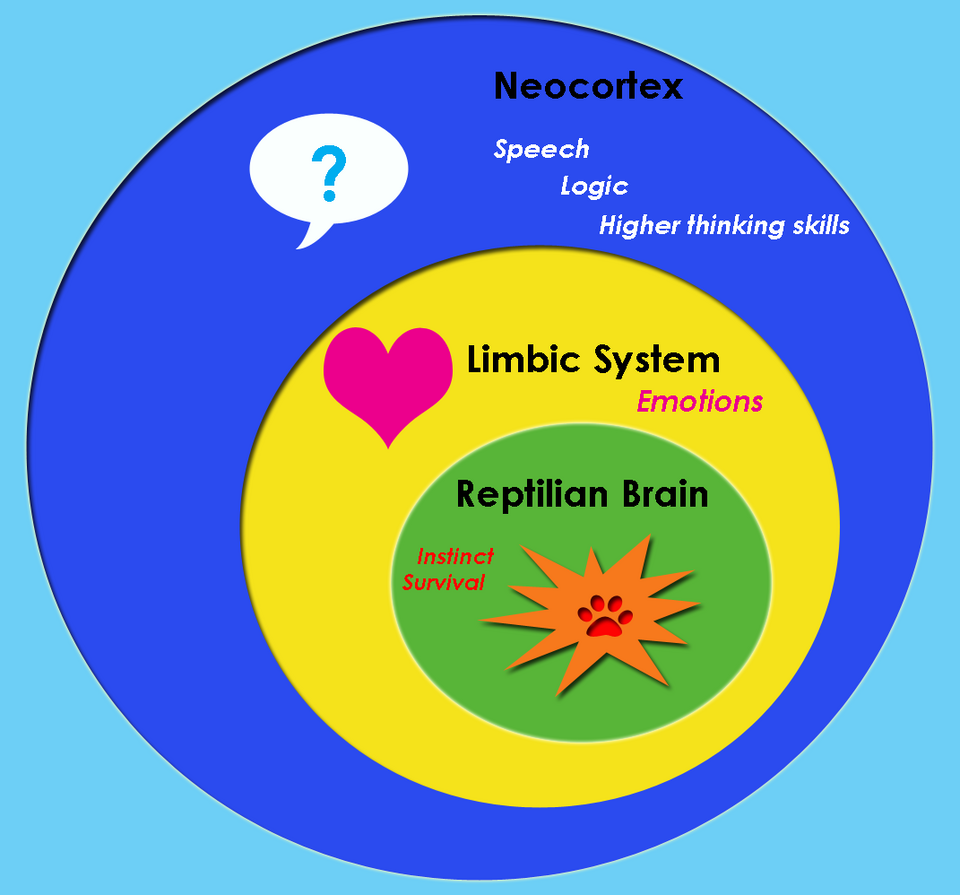 ExpandThe Triune Brain Model: evolutionary layers from the reptilian core to the human neocortex
The Triune Brain Model explains that we have three layers of brain, each from a different time in history, all working together inside your head right now.
[!TIP] For a much deeper look at the biology of how these layers interact, read my breakdown of Robert Sapolsky's research: The Biology of Our Best and Worst Selves.
1. The Reptilian Brain (Survival)
This is the oldest part. It runs on pure instinct. No emotions. No thought.
- Job: Eating, breathing, and keeping you alive.
- Reaction: Acting fast when there's danger or a chance to take control.
- Triggers: It responds most powerfully to alarm and power. When you jump back from a snake without thinking, that is this brain in control.
2. The Mammalian Brain (Emotion)
This layer formed around the reptilian core. This is where your "gut feelings" actually live.
- Job: Passion, trust, desire, and feeling like you belong.
- Decision-Making: Most of our daily decisions are made here, driven by how we feel, not logic. It’s the part that decides who to trust and what to crave.
3. The Neocortex (Thinking)
This is the newest, human brain. It's the part that lets us write books, solve math problems, and plan for the future.
- Job: Logic, language, and complex ideas.
- The Catch: The thinking brain almost never makes the actual decision. Its job is to make up a reason afterward to justify what the emotional brain already decided to do.
The Logic Puzzle That Proves It
We think we are logical, but we are actually masters of making up reasons afterward. Your emotional brain makes the call, and your thinking brain builds a story to explain why it was "smart."
Here is a puzzle to prove how easily our thinking brain shuts down:
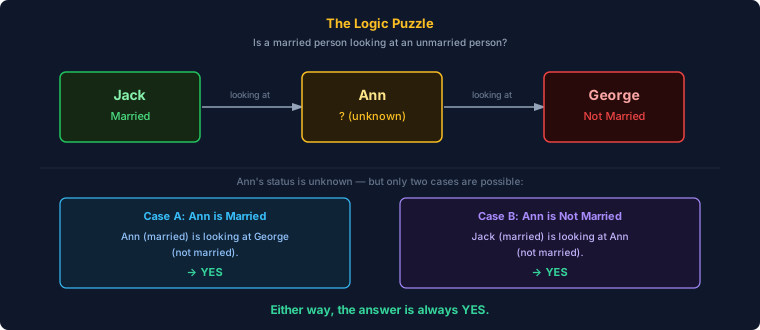 ExpandJack, Ann, and George: the logic puzzle visualised
Jack is looking at Ann. Ann is looking at George. Jack is married. George is not. Is a married person looking at an unmarried person?
A) Yes B) No C) Cannot be determined
Almost everyone says Cannot be determined. But the answer is Yes. We stopped thinking the moment we hit the first piece of missing information (we don't know if Ann is married).
The takeaway? We're not irrational. We're just running very, very old software in a relatively new world. Understanding this won't change your brain, but it helps you understand why the animal inside you reacts the way it does.
Further Reading and Watching
Keep reading