What is High-Level Design (HLD)?
The mental model shift from DSA to HLD. Why scaling to billions of users is not just faster code - it is a scenario-based discipline of survival.
The thing nobody tells you about High-Level Design is that it is not really about "designing" at all - it is about survival. I used to think HLD was just DSA for bigger machines, until I realized that scaling to billions of users requires a completely different mental model.
The Problem-Solving Hierarchy
Looking back, my engineering journey was split into three distinct shifts in how I approached a problem:
- DSA (Data Structures and Algorithms): This is where I solved for algorithmic speed. It is about optimizing code to make it go fast and ensuring it uses memory efficiently.
- LLD (Low-Level Design): This is where I solved for manageability. I had to architect my codebase so that it was easy to maintain, readable, and flexible enough that changing requirements didn't force a total rewrite.
- HLD (High-Level Design): This is where I solved for scale. I was no longer looking at individual lines of code or classes; I was looking at how to handle billions of requests and terabytes of data across a distributed system.
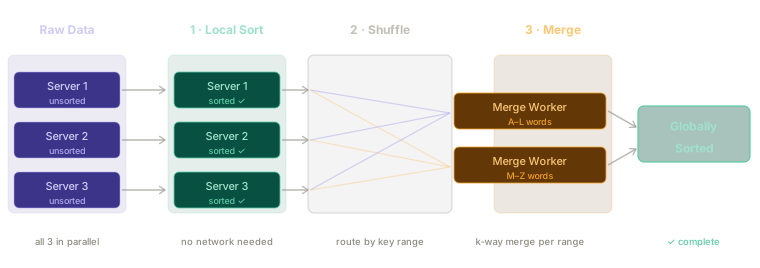 ExpandMapReduce Phases and the 50PB Sort Challenge
Scaling to Billions
In HLD, the numbers are different. We aren't talking about optimizing a function to handle a thousand items. We are talking about designing systems like Twitter, Uber, or Netflix that must remain responsive while serving massive traffic.
One unique challenge I found is that HLD is a Scenario-Based discipline. In DSA, you can write code and run it. In LLD, you can build a project. But in HLD, you cannot simply "build" a system for 1 billion users on your local laptop to see if it works. Load testing a system at that scale would cost millions of dollars and require massive infrastructure.
Because of this, the best way to learn HLD is through Case Studies. We dissect existing architectures and propose solutions to massive scaling problems. It is about the architect bridge between code and configuration.
When does HLD matter?
The importance of HLD changes as your career progresses:
- Entry-Level (SDE 1): Most companies focus on your DSA and LLD skills. While basic HLD knowledge is helpful, you are rarely asked to design a massive distributed system in an entry-level interview.
- Senior Roles (SDE 2 and Higher): HLD becomes mandatory. At this level, you are expected to know how to set up load balancers, choose the correct database for a specific use case, and ensure system resilience.
To truly master HLD, you need a solid foundation in the previous tracks. If you have significant backlogs in DSA or LLD, I strongly recommend focusing on those first. HLD builds upon the assumption that your code is already efficient and your components are already well-architected.
So, where do we start? Instead of talking about abstract theories, I want to take you back to 2003 - to a "Cyber Cafe" in India where a small bookmarking app called Delicious was born. That is where the first real scaling problems began to surface.
The Essentials
- HLD is not about writing better code - it is about designing systems that survive at billions of requests by making architectural decisions across machines, networks, and data layers.
- The three tiers of engineering (DSA for speed, LLD for manageability, HLD for scale) build on each other - HLD assumes your code and components are already solid.
- Because you cannot run a billion-user test locally, HLD is learned through case studies of real systems - dissecting what worked and why.
Further Reading and Watching
- Gaurav Sen - Introduction to System Design - A solid primer on why system design matters for senior engineering roles.
- System Design Primer (GitHub) - The most popular open-source reference for system design concepts, used by engineers worldwide.
Practice what you just read.
Keep reading