Vertical vs Horizontal Scaling: Why 500 Laptops Beat One Supercomputer
Two strategies for handling more traffic: make your server taller or add more servers. Why vertical scaling always hits a ceiling, and how horizontal scaling changes everything.
Joshua has a 40-day clock. His server fills 1 GB of storage every day and has 40 GB left. He needs more capacity. There are exactly two ways to solve this, and understanding both is the foundation of every HLD decision that follows.
Strategy 1: Vertical Scaling (Scale Up)
Vertical scaling means replacing your current server with a more powerful one. Same machine count - just taller.
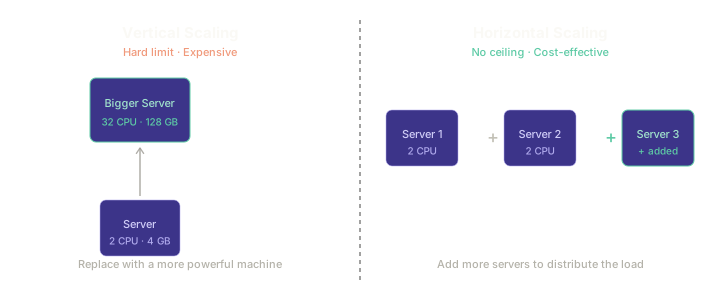 ExpandVertical vs Horizontal Scaling Strategy
Level 1: The Consumer Upgrade
Joshua buys the best gaming PC in the shop for ₹2 lakhs.
- Specs: 256 MB RAM, 80 GB Hard Disk.
- The Result: He doubled his storage, bought another 40 days. But because load is growing exponentially, within three months he is back at the store.
Level 2: Server-Grade Hardware
This time, he moves beyond consumer electronics and buys server-grade hardware from IBM for ₹1 crore.
- Specs: 1 GB RAM, 8-core CPU, 500 GB Hard Disk.
- The Difference: Unlike a gaming PC, server-grade hardware uses custom motherboards built for 24/7 commercial reliability.
The Law of Diminishing Returns
Joshua spent ₹1 crore - over 280 times the cost of his original laptop - but did not get 280 times the runtime. This is the Law of Diminishing Returns:
- Exponential Cost: To double performance at high tiers, you often pay 10x or 100x the price.
- Linear Gains: Hardware eventually hits a plateau while traffic continues to grow.
The only remaining step is a Supercomputer - a research project costing hundreds of millions of dollars and five years to build. For a bookmarking site, that is insane.
[!IMPORTANT] The core problem with vertical scaling is the keyword Replacement. You throw away the old machine and buy a new one. Eventually, the machine you need does not exist yet.
Even in 2025, the most powerful single server available has up to 12 TB of RAM, 2 PB of Flash storage, and costs around ₹5 crore per year to run. That ceiling still exists.
Strategy 2: Horizontal Scaling (Scale Out)
Instead of replacing the machine, add more machines alongside it. This is how Google, Meta, and every large-scale internet company actually works.
The Rock vs. 1,000 People
Imagine a ₹1 crore budget for a fight. Two options:
- Vertical: Hire The Rock - elite, powerful, one person.
- Horizontal: Hire 1,000 people from your hometown with food and beer.
The 1,000 people win every time. In HLD, those 1,000 people are Commodity Hardware - cheap, standard servers that are unremarkable individually but unstoppable as a group.
The Economy of Scale
When you buy one laptop, you pay retail. When you buy 500, you negotiate directly with manufacturers.
Take the NVIDIA H100 GPU:
- Retail Price: ~$30,000 (₹25 lakhs)
- Manufacturing Cost: ~$1,000 (₹85k)
- The Markup: 30x
For the same ₹1 crore that bought Joshua one IBM server, he could buy 500 cheap laptops. Here is what the numbers look like:
| Resource | Single IBM Server | 500 Laptops | Improvement |
|---|---|---|---|
| RAM | 1 GB | 64 GB | 64x |
| CPU Cores | 8 Cores | 1,000 Cores | 125x |
| Storage | 500 GB | 16 TB | 32x |
Same budget. Over 100x more capacity.
Why Horizontal Scaling Is Mandatory - Not Optional
If it is 100x better, why not do it from day one? Because horizontal scaling is a massive operational challenge.
- Vertical is easy: You do not change your code. You just buy a faster machine.
- Horizontal is hard: Once you have 500 machines, you have 500 new problems. How do you distribute traffic? What happens when 5 laptops crash? How do you keep data in sync?
[!IMPORTANT] The entire HLD curriculum exists because horizontal scaling is difficult. Every concept - Load Balancers, Sharding, Consistent Hashing - is a solution to a problem created by scaling out.
You start vertical because it is simple. You eventually go horizontal because you have no other choice. The next question is: once you have 500 machines, how does a user's request know which one to go to?
The Essentials
- Vertical scaling (replacing a server with a more powerful one) hits the Law of Diminishing Returns - the cost grows exponentially while the gains grow linearly, until no machine powerful enough exists.
- Horizontal scaling (adding more commodity machines) gives dramatically more capacity for the same budget - 500 laptops for ₹1 crore vs. one IBM server delivers over 100x the resources.
- Horizontal scaling is not optional at internet scale, but it introduces a new class of problems - traffic distribution, crash handling, and data sync - which is exactly what the rest of HLD solves.
Further Reading and Watching
- Gaurav Sen - Horizontal vs Vertical Scaling - A concise explanation of both strategies with real-world trade-offs.
- AWS - Scale Up vs Scale Out - Amazon's own documentation on when to choose each strategy in production cloud architectures.
Keep reading