In His Will There Is Our Peace:Picarda, Canto III
Picarda was wronged. She ended up in the lowest sphere. And she says she is perfectly content. The paradox is harder:and more human:than it looks.
The degree to which you receive God's light is a matter of what you are and what you will.
That claim becomes real the moment Dante meets the first soul in the moon.
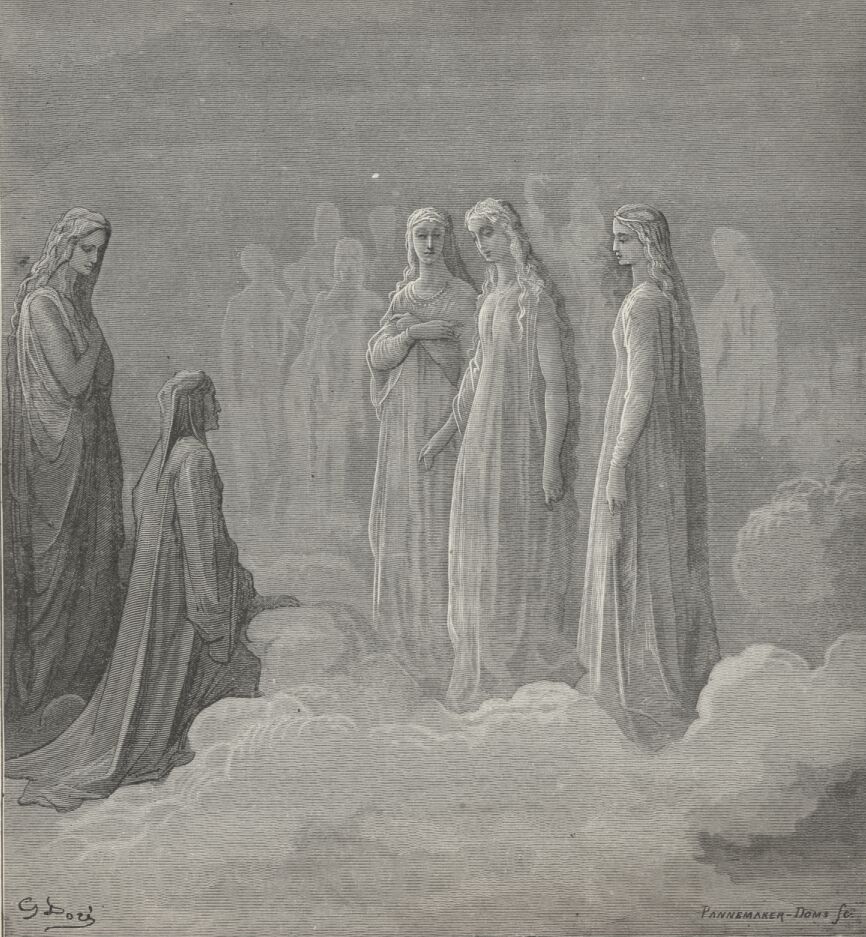 ExpandGustave Doré's engraving for Paradiso Canto III — Dante encounters the souls in the sphere of the Moon, among them Piccarda Donati, 1868
Canto III: Who Is in the Moon?
Dante sees something strange: faces appearing faintly in the sphere of the moon, like reflections on still water or like a pearl against a white forehead, barely visible. He turns around to see who they are, finds no one behind him, and realizes: these are not reflections.
They are souls.
Beatrice clarifies: "What you are seeing are true substances, placed here because their vows were not fulfilled."
Picarda: "In His Will There Is Our Peace"
The first soul Dante speaks to is Picarda. She was a nun, a real woman Dante knew in Florence, who made her vows to God and entered a convent. Her brother, a powerful duke who needed her as a political pawn, sent soldiers to drag her out and married her off against her will. She never stopped loving God. Her body was violated. Her heart, she says, remained chaste.
She lives in the lowest sphere of Paradise: those who failed to fulfill their vows.
Dante asks the obvious question: don't you want to move higher? Closer to God?
Her answer is the most famous line in all of Paradiso.
"In his will there is our peace, that sea to which all beings move."
She does not want to go higher. To want more would be to want something other than what God has willed for her, and that discord, she says, is not possible here.
The Paradox Beatrice Will Not Let Pass
This is where the poem turns sharp.
Picarda did nothing wrong. She was taken by force. She made her vows in good faith and had them stripped from her by men with swords. She maintained her love for God through everything that followed. And she is in the lowest sphere.
Earlier, the argument was that God is all-loving, not judgmental. He does not assign weights. Yet here is a woman who was wronged, who is not at the highest level, and who is perfectly content to stay where she is.
What did she do wrong?
The answer is not what happened to her. The answer is what she did not do.
Where There Is a Will, There Is a Way
The resolution is one of the most demanding ideas in the poem.
If she had truly willed to escape, an idea would have come. The imagination would have found a path. And the universe would have bent reality to allow that path to be walked.
Soldiers with swords were involved. Her options were genuinely constrained. But the argument is that constraint is never the deepest problem. The deepest problem is will.
She prayed. She was afraid. And the fear itself is the tell: it reveals that she did not fully trust God. To truly believe is to not fear the soldiers, not fear the unknown.
"Where there is a will, there is a way" is not a motivational phrase. In Dante, it is a law of the universe.
If you will something completely, with your entire imagination focused on it, the universe shapes itself around that will. Picarda did not will escape completely enough.
Free Will Is About Willing What You Want
One clarification that matters: free will, in Dante's conception, is not simply the ability to do what you want.
It is the ability to will what you want.
The action follows the will. The will is primary. What Picarda lacked was not freedom of movement but strength of desire. Her will was not focused enough to pull the universe toward her.
In the universe Dante describes, there is no good and evil at the deepest level. There is only will. What you truly, completely desire: that is what you become. Everything else is fear dressed up as contentment.
This connects to ideas across many traditions. Nietzsche called it the will to power. Albert Bandura, the psychologist, called it self-efficacy: the belief in your ability to accomplish something is the primary predictor of whether you do. Contemporary culture calls it manifestation. The vocabulary changes. The underlying claim is the same: you imagine it because you will it into being. The imagination is the instrument; the will is the force behind it.
"God Just Wants Me Here" Is a Pretext
Picarda says she is content. But contentment and acceptance are not the same thing.
She is afraid. Afraid of failure, afraid of disappointment, afraid of wanting something and not getting it. "God has willed me here" is the story she tells herself to avoid the leap. It is a deeply human reaction. We tell ourselves we are happy where we are, and we mean it, because imagining something better and failing to get there feels worse than not trying.
But the story is a pretext. The fear is the real reason.
What Picarda Could Have Done
To make the will argument concrete, consider what a fearless Picarda might have done when the soldiers arrived.
She climbs to the roof. She looks down at the army. She says: come through that door and I will jump.
The soldiers' job is to deliver her safely to the duke. A dead Picarda is a failed mission. So they stop. The duke comes himself. She does the same thing again. He cannot storm the convent without risking her death. He eventually goes home.
God is not pulling a miracle here. The will is the miracle. When you act with complete faith and total focus, other people's calculations change around you. The obstacle dissolves. Not because the universe suspends physics, but because the human beings on the other side of it respond differently to someone who is not afraid.
The army ran out of options. Picarda ran out of will.
In Canto IV, Dante asks the harder question this raises: if the spheres represent rank, and rank reflects will, does God actually place some souls lower than others? The answer will overturn everything.
The Essentials
- Picarda is in the lowest sphere not because of what was done to her, but because of what she did not do. The soldiers did not defeat her. Her own fear defeated her.
- Free will is about willing what you want, not just doing what you want. Picarda had freedom of action constrained but her absolute will was never extinguished. The problem was that it was not focused enough.
- "In his will there is our peace" is true and also a pretext. Picarda's absolute will remained loyal to God. But she rationalized her passivity as obedience. They are not the same thing.
Further Reading
- Book: The Divine Comedy by Dante Alighieri, trans. Allen Mandelbaum, with facing Italian text.
- Wikipedia: Picarda Donati · Paradiso, Canto III · Vow
Keep reading